Canada Trademark Registration: Complete Country Practice Guide
Note: This page gives general information about Canadian trademark registration and is not legal advice. Reading it does not create an attorney-client relationship. Fees, deadlines and procedures change, and the information here was compiled in October 2026.
What Is a Trademark?
A trademark is a sign used, to distinguish the goods or services of one business from those of others. Words, names and designs are the usual forms. Since the 2019 reforms the register also accepts non-traditional marks such as colours, sounds and three-dimensional shapes.
Registration gives the owner the exclusive right to use the mark throughout Canada in connection with the registered goods or services, subject to applicable legal limitations.
Use-Based Rights vs. Federal Registration
Rights in a trademark can arise through use in Canada, and registration adds nationwide protection. Registration is not mandatory.
Canada
Protect Your Trademark in Canada
Have a mark you’d like to protect in Canada? Write to us at global.ipr@blueinkk.com or fill out our Connect With Us form and our team will get in touch.
Aspect | Unregistered (use-based) rights | Federal registration (CIPO) |
|---|---|---|
How rights arise | Use of the mark in Canada | Application, examination and registration. Use before registration is not required |
Geographic scope | Generally limited to the area where the mark is used and known | Exclusive right across Canada |
Enforcement | Relies on common law protection, which is harder and costlier to prove | Registration certificate and entry on the Register of Trademarks |
Term | None fixed | 10 years, renewable |
Vulnerability | Can be lost if use stops | Can be expunged for reasons such as non-use, abandonment, non renewal or loss of distinctiveness |
Trademark Symbols: TM, MC and ®
Canada does not make marking mandatory, but symbols tell others that a claim is being made. Canada is officially bilingual, so a French equivalent of TM is in common use.
Symbol | Name | Used for | Registration needed? |
|---|---|---|---|
TM | Trademark | Signals a claim of trademark rights in English-language use | No |
MC | Marque de commerce | French-language equivalent of TM | No |
® | Registered trademark | Marks registered with CIPO | Yes. Use only once registration has been granted |
WIPO / Madrid Protocol Status
Canada joined the Madrid Protocol on 17 June 2019, so it is a WIPO-system jurisdiction: a mark can be protected here through an international registration, and Canadian applicants can use the system to protect marks abroad.
The Madrid Protocol is a treaty administered by the World Intellectual Property Organization (WIPO). It lets an owner seek trademark protection in several member jurisdictions through one centralised filing.
Route | Who uses it | How it works |
|---|---|---|
Outbound | Canadian applicants seeking protection in other Madrid members | International application filed through CIPO as the office of origin, based on a Canadian application or registration |
Inbound | Foreign applicants designating Canada | International registration designating Canada, examined by CIPO under Canadian law |
Important limits
An international registration does not automatically give protection in Canada. CIPO examines each designation and may refuse protection.
The Madrid System simplifies filing and portfolio management. It does not replace national examination.
Applicable Law and Authority
Canadian trademark registration is governed by the Trademarks Act and its Regulations and administered by CIPO.
Instrument / body | Role |
|---|---|
Primary federal statute on trademark registration and protection. | |
Procedural rules, prescribed periods, fees schedule and Madrid (Protocol) application rules | |
Canadian Intellectual Property Office (CIPO) | Competent authority, part of Innovation, Science and Economic Development Canada; receives, examines and registers applications |
Nice Classification | International classification of goods and services used to organise applications by class |
Madrid Protocol | International filing system administered by WIPO; Canada is a member. |
Common law | Governs use-based rights in unregistered marks, generally limited to the area of use |
Multi class Application | Allowed |
Steps of Filing
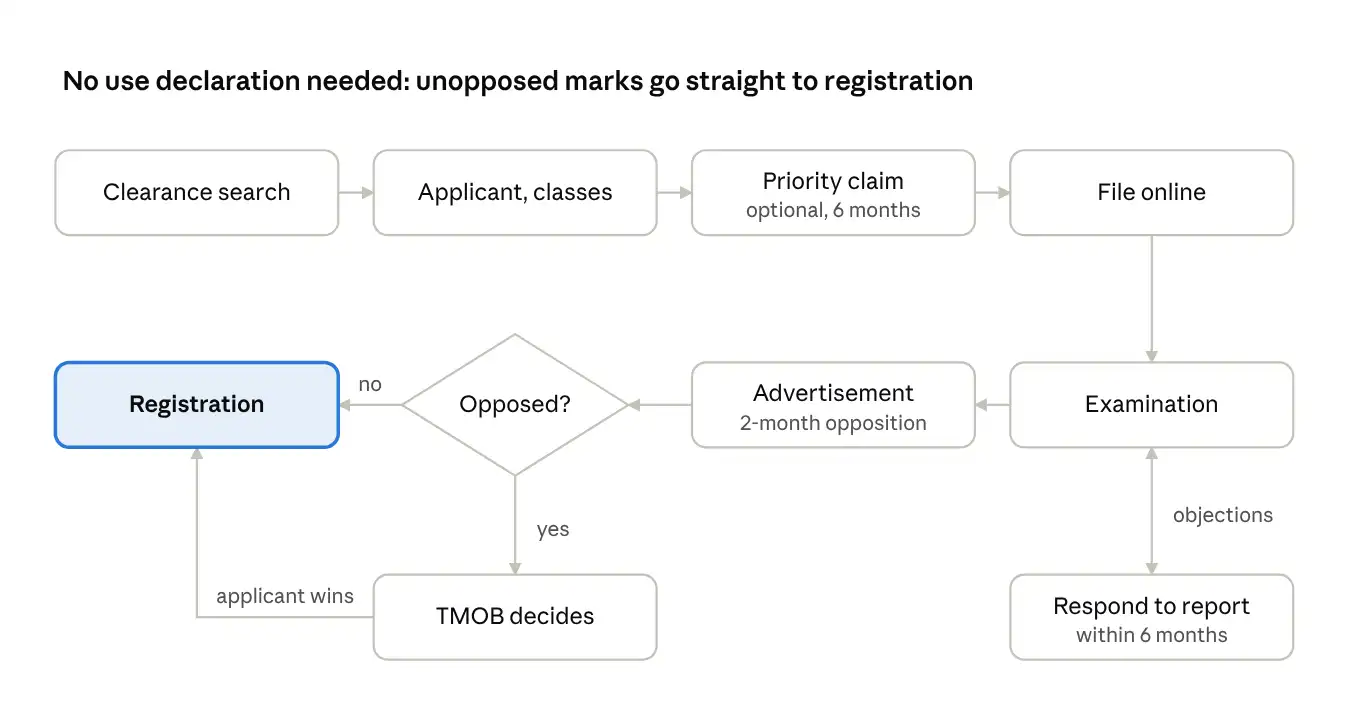
A Canadian application moves through seven stages. There is no filing basis to choose, no specimen and no Statement of Use, which makes the process shorter than the U.S. one.
Registration Process
Trademark search
Identify the applicant, mark and goods/services
Decide the filing route
File the application
Examination by CIPO
Advertisement and opposition
Registration
Filing Routes and Priority
Canada has no equivalent of the U.S. Section 1(a), 1(b) or 44 bases. The route depends on how the application reaches CIPO.
Route | When it applies |
|---|---|
Standard application | Any applicant. No prior use in Canada or foreign registration is needed |
Priority claim (Trademarks Act, s. 34) | Canadian application filed within six months of the earliest foreign application for the same mark. The request must be filed in the prescribed time and manner. |
Madrid designation | International registration designating Canada through WIPO; CIPO examines it under Canadian law (Section 2) |
Official Fees
The base application fee is CAD 491.06 for the first class filed online in 2026, plus CAD 149.04 for each additional class.
Application Stage
Item | 2026 fee (CAD) | From 1 Jan 2027 (CAD) | Notes |
|---|---|---|---|
Application, first class, filed online | 491.06 | 499.41 | Covers the first class |
Additional class | 149.04 | 151.57 | Per extra class, at filing, any method |
Examination, Opposition and Recording Fees
Item | 2026 fee (CAD) | From 1 Jan 2027 (CAD) | Notes |
|---|---|---|---|
Extension of time (s. 47) | 150.00 | 150.00 | Per act; not subject to the annual adjustment |
Statement of opposition (s. 38(1)) | 1,115.08 | 1,134.04 | Payable by the opponent |
Section 45 notice (evidence of use) | 595.06 | 605.18 | Per notice; payable by the requesting party |
Recording a transfer of an application (s. 48(3)) | 125.00 | 125.00 | Per application |
Registering a transfer of a registered mark (s. 48(4)) | 125.00 | 125.00 | Per mark |
After Registration
Renewal fees are set out with the renewal window in Section 8.2.
Illustrative Minimum Cost (2026, online filing, official fees only)
Scope | Official fees (CAD) |
|---|---|
One class | 491.06 |
Three classes | 789.14 (491.06 + 2 x 149.04) |
These figures exclude agent fees, and any extension, opposition or response costs.
Agent / Representative Requirement
A Canadian trademark agent is not mandatory, including for foreign applicants, but only a registered agent may represent others before CIPO. This differs from the U.S., where foreign-domiciled applicants must use a U.S.-licensed attorney.
Applicant / filing type | Agent required? |
|---|---|
Applicant resident in Canada | No. Optional but advisable |
Non-resident applicant (e.g. India) | Not mandatory. Advisable, particularly once CIPO raises objections or an opposition is filed |
Madrid designation of Canada | Filed through WIPO. An agent is advisable if CIPO issues an objection |
Validity, Renewal and Maintenance
A Canadian registration lasts ten years and is kept alive by renewal alone. There are no mid-term use declarations, but the mark stays open to a non-use challenge from year three.
Term
A registration is valid for ten years from the registration date and may be renewed for successive ten-year periods on payment of the renewal fee. Canada has no equivalent of the U.S. Section 8 or Section 15 declarations.
Renewal Window and Fees
Item | 2026 fee (CAD) | From 1 Jan 2027 (CAD) | Notes |
|---|---|---|---|
Renewal, first class, filed online | 595.06 | 605.18 | Mandatory every 10 years |
Renewal, first class, other means | 744.10 | 756.75 | |
Renewal, each additional class | 185.49 | 188.64 |
Renewal window. Payment can be made from 6 months before the end of the initial or renewal period. It closes at the later of 6 months after that period ends, or 2 months after the Registrar's reminder notice. If the fee is not paid in time, the registration is expunged and treated as expired at the end of the period.
Non-Use Challenge (Section 45)
After 3 years from the registration date, the Registrar can issue a notice on its own initiative, or on request from any person who pays the fee (Section 6.2).
The owner has 3 months to file an affidavit or statutory declaration showing use of the mark in Canada during the 3 years before the notice.
If there was no use, and no special circumstances excuse it, the registration can be expunged or amended.
Registrar decisions can be appealed to the Federal Court of Canada.
A registration can also be expunged for other reasons, such as abandonment or loss of distinctiveness.
Protect Your Trademark in Canada
If you’re an Indian brand looking to protect your trademark in Canada, get in touch with our team for a consultation and a clear filing roadmap tailored to your goods or services. Write to us at global.ipr@blueinkk.com , or fill out our Connect With Us form and we’ll reach out to you.